
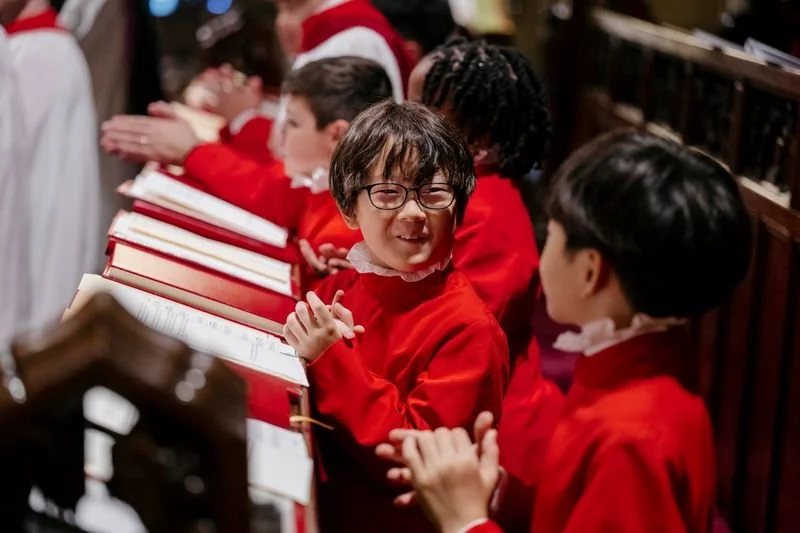
Saint Thomas Choir School
2009 – 2010 Syllabus
(March through April, 2010)
English – Emily Smith
5th Grade
- The fifth grade will begin with a unit on poetry. They will read and produce
poems in different styles and learn literary terms to discuss poetry. We will
then read Hoot by Carl Hiaasen and
write persuasive essays. Grammar instruction will focus on adverbs and
prepositions.
6th Grade
- The sixth grade will begin with a Shakespeare unit. They will read Romeo and Juliet and then perform and
film scenes from the play. We will discuss Shakespeare’s language as well as
his influences on modern literature. In April they will study poetry, reading
and producing poems in different styles.
7th Grade
- The seventh grade will begin with a Shakespeare unit. They will read The Tempest and then perform and film
scenes from the play. We will discuss Shakespeare’s language as well as his
influences on modern literature. In April they will study poetry, reading and
producing poems in different styles.
8th Grade
- The eighth grade will begin with a Shakespeare unit. They will read The Merchant of Venice and then perform
and film scenes from the play. We will discuss Shakespeare’s language as well
as his influences on modern literature. In April they will study poetry, reading
and producing poems in different styles.
French - Delia
Ahouandjinou Geter
3/4th Grade - Grades 3 and 4
will continue the play "Boucles Violette et les Trois Ours”. They will broaden
their knowledge of basic vocabulary. Themes such as days of the week, body
parts and counting will be developed. They will work with incomplete questions
(when the answer is not included in the question).
5/6th Grade - Grades 5 and 6
will continue the play "Louis la Grenouille”. They will formalize their understanding
of concepts such as infinitive, 3rd person in present tense,
contractions and pronouns.
7/8th Grade - Grades 7 and 8
will continue the play "Le Petit Chaperon Rouge”. They will work with forms of
past tense (passé compose and imparfait) and object pronouns.
History – Mary Beth Benbenek
4th Grade - Now that grade
four has finished studying ancient Egypt, we will move on to a brief
examination of the ancient Hebrews and Phoenicians. We will then shift our attention to the east
to explore the culture and history of ancient India, where we will focus
primarily on Hinduism and Buddhism.
After India, we will
turn to China
to study the ancient dynasties, including the Qin and the Han, and ancient
Chinese philosophies, Confucianism and Taoism.
In addition to class projects, the boys will continue to have several
writing assignments, quizzes, and tests
5th Grade - We are moving at
a brisk pace through ancient Rome;
so far we have covered a great deal, from the founding legends to the Punic
Wars. We will now move on to the decline
of the republic from the Gracchi brothers to Julius Caesar and the emergence of
the empire under Augustus. By term’s end, we will have examined
the rise of Christianity, the fall of the western half the Roman Empire, the Byzantine Empire, and the rise of Islam. The boys will
continue to have both long and short writing assignments, quizzes and
tests.
6th and 7th Grade
- Currently, grades six and seven are completing essays on the rise of the
Shogun system in medieval Japan.
Next we will shift attention to the civil examination system in Song Dynasty
China, the Mongol Empires of both Genghis and Khubilai Khan, Zen arts, and
Marco Polo’s
travels to the east during Yuan Dynasty China.
By the term’s end, we will have turned our attention back to Europe to explore the Renaissance and the
Reformation. The boys will write several
short and long essays this term in addition to the standard assignments,
quizzes and tests.
8th Grade - After just
completing essays comparing the French and American Revolutions, the eighth
grade has moved on to the U.S. constitution and Bill of Rights, studying the
ideas and debates that helped shape these all-important documents. After exploring the successes and failures of
the first three presidents, Washington, Adams, and Jefferson, we shall turn our
attention to the era of Jacksonian Democracy.
By term’s
end, we will have examined the Civil War and the Reconstruction Era. The boys
will continue to have several two to three-page writing assignments, along with
a slightly longer research paper.
Latin – John Lee
6th Grade – Now that we just
finished a major vocabulary and form test, we will move on to explore the case
system of Latin grammar in more detail. We will also introduce two more verbal
tenses.
7th Grade – We move onto the second
book of the Oxford Latin series. We will examine more nuances of Latin grammar
with a special emphasis on verbal tenses and forms and subordinate clauses.
8th Grade – The goal is to prepare
the eighth grade for high school. For this reason, we will do some review (just
finished a comprehensive test on forms), and cover more sophisticated
grammatical points. We will also be moving onto the final book of the Cambridge
Latin Course by the end of the school year.
Math – Michael Rose
4th Grade - The fourth grade
will be studying the following topics:
*
Geometric Figures
*
Fraction Concepts
*
Multiplication and Division of Fractions
*
Addition and Subtraction of Fractions
*
Decimals and Percents
*
Area and Perimeter
*
Three-Dimensional Geometry
5th Grade - The fifth grade
will be studying the following topics:
*
Fraction Operations: understanding and skill with addition, subtraction,
multiplication, and division of fractions.
*
Statistics: formulate questions; gather, organize, represent, and analyze data;
interpret results from data; measures of center and range.
*
Computing with Decimals and Percents: understanding and skill with addition,
subtractions, multiplication, and division of decimals; solving percent
problems.
6th Grade - The sixth grade
will be studying the following topics:
*
Positive and Negative Numbers: understanding and modeling positive and negative
integers and rational numbers; operations; distributive property; four-quadrant
graphing.
*
Similarity: similar figures; scale factors; side length ratios; basic
similarity transformations and their algebraic rules.
*
Ratio, Proportion, and Percent: rates and ratios; making comparisons;
proportional reasoning; solving proportions.
7th Grade - The seventh grade will be
finishing topics in Algebra 1 and moving on to the following topics in Algebra
2 - Polynomials and Factoring; Radical Expressions and Equations; Matrices;
Logarithmic Functions; Probability and Statistics; Periodic Functions and
Trigonometry.
8th Grade - The eighth grade
will be finishing topics in Algebra 1 and moving on to the following topics in
Algebra 2- Polynomials and Factoring; Radical Expressions and Equations;
Matrices; Logarithmic Functions; Probability and Statistics; Periodic Functions
and Trigonometry.
Music Theory – Scott Eyerly
3rd Grade
– Construction of major and minor thirds [new]
Singing strings of scale degrees, as numbers and note names,
from C, G, F [new]
Melodic dictation in treble clef, bass clef and grand staff
[continuation]
Performing longer rhythm exercises with ties, dots and rests
[continuation]
Introduction of key signatures [new]
4th Grade
– Review of intervals: 3rds, 4ths and 5ths [continuation]
Construction of major and minor 6ths [new]
Review of sharp key signatures [continuation]
Flat key signatures [new]
Rhythms with half beats in 2/4, 3/4 and 4/4 [continuation]
Sight singing [continuation]
5th Grade
– Introduction of minor keys [new]
Circle of 5ths with minor as well as major keys [new]
Review of all intervals within the octave (M, m, P, d, A)
[continuation]
Syncopation [continuation]
Sight singing [continuation]
N.B.: Grades 6, 7 and
8 will be attending a performance of Puccini’s "Madame Butterfly” by the
New York City Opera on March 25 at Lincoln
Center. This is an
extraordinary opportunity for the boys to see an operatic masterwork, one of
the 2 or 3 most popular operas in the repertory. I’ll be presenting special
classes to these three grades leading up to the performance, in which we’ll
listen to recorded excerpts, sing parts of the score, learn the story and
background, sketch set designs, and generally immerse ourselves in this
wonderful opera.
The syllabus below concerns regular Music Theory classes,
post-Puccini:
6th Grade
– Review of natural, harmonic and melodic minor scales [continuation]
Introduction of parallel minor keys [new]
Synthesis of major, relative minor and parallel minor keys
[new]
Longer exercises in compound time (6/8, 9/8, 12/8)
[continuation]
Sight singing [continuation]
7th Grade
– Construction of the subdominant or "IV” chord [new]
Harmonization of familiar melodies [continuation]
Introduction of harmonic cycle [new]
Longer exercises in compound time (6/8, 9/8, 12/8) [new]
Sight singing [continuation]
8th Grade
– Review of 1st Species counterpoint [continuation]
2nd Species counterpoint [new]
Introduction of V7/IV chord [new]
Synthesis of all secondary dominants used thus far (V/V,
V/vi, V7/IV) [new]
Polyrhythms [continuation], going on to 4:3 and 3:4 [new]
Physical Education – Nathan Holst
3rd/4th
Grade – Grades 3 and 4 will be working on teamwork, endurance and
self-awareness. We will be moving on to kickball and hockey to work on learning
rules of sports that are played at the older levels.
5th/6th
– Grades 5 and 6 will work on group building using hockey and kick ball. We
will begin softball at the end of March.
7th/8th
– Grades 7 and 8 will be working on endurance and strength building through
hockey, running and kickball. We begin softball at the end of March.
Science – Dr. Matthew
Gilbert
5th Grade
- In fifth grade earth science, we will continue our study of space. We are finishing up our discussion of
inertia, gravity, velocity, acceleration, and the shape of orbits, and are now
moving up to stars, galaxies, and the universe.
Toward the end of the term we will study erosion and weathering, and the
oceans.
6th Grade
- In sixth grade life science, we will continue our study of ecology. We have looked at predator-prey simulations,
how organisms become adapted to their environments, and the kinds of
relationships organisms have with one another (symbiosis). We will now study ecosystems, and move on to
plant biology. Concepts to be studied
include types of ecosystems, food chains and food webs, energy pyramids,
populations and communities, and cycles of water, nitrogen, and carbon.
7th Grade -
In seventh grade physical science, we have completed our discussion of motion,
waves, electromagnetic radiation, electricity and circuits. We will now move on to the study of simple
machines, such as pulleys and levers. We
will cover such concepts as mechanical advantage, torque, force, springs, and
elastic potential energy. Later we will
discuss forces in fluids, including surface tension and pressure.
8th Grade
- In eighth grade biology, we will continue our discussion of human
physiology. We have just concluded our
study of renal (kidney) physiology, and have just begun respiratory physiology. We will examine how oxygen enters the lungs and
is transported by the circulatory system to all body tissues, as well as how
carbon dioxide is removed from the body.
We will cover metabolism and physiologic adaptations to altitude and
exercise. Later in the spring, we will
study the immune system, and the endocrine and exocrine systems.
Theology – John Lee
The goal for all grades will be to continue with our survey
of the Old Testament. We just finished the Pentateuch and now we are beginning
the life of David. The goal is to show that there is a theological unity to the
Bible that climaxes in the story of the birth, death and resurrection of
Christ.
Grade 3 and 4 – Steve Kelly
English
Writing
-
Continue creative writing with stories that have
circular endings.
-
Continue working with persuasive writing.
-
Begin writing poetry.
-
Begin expository writing using the tropical rain
forest as the main topic.
Vocabulary
Move on to Greek word parts, coined words, word stories,
newspaper jargon, prefixes and suffixes.
Continue to use words from the books we are reading in
class. Practice using context clues.
Continue working with word analogies.
Spelling
Vowel pairs and digraphs, plurals, possessives, prefixes,
compound words synonyms antonyms and homonyms.
Reading
Fiction = The Voyages
of Doctor Dolittle, A Wrinkle in Time
Nonfiction = One Day
in the Tropical Rain Forest
Primary and secondary sources for information about tropical
rain forests
Science
Continue with, and finish, unit on measurement. Unit
finishes with experiments on temperature.
Begin and complete unit on tropical rain forests. Class
installation creating a rain forest is made.
Grade Three History
Continue with survey of New York
history: The British in New York; The
Revolutionary War; New York’s growth into a
preeminent city; Industries; modern New
York.
Grade Three Mathematics
Multiplication and division, fractions, geometry,
measurement, and probability
Daily Homework
Parents can follow
homework assigned by the teachers each evening in study hall.
Go to: docs.google.com
Email:
choirschoolparent
Password:
stthomas
Click on "Study Hall"